Popular

Friday, January 17, 2014

Dear Honey

Dear Honey,

When i left you 6 months ago i was excited and egger to fight in war. I soon found out that war wasn't all i thought it was. The smell of rotting corpses is very prominent and death is surrounding us. During our free time we sit around and play cards, occasionally we get some coffee. But the reality off all this is that good men are dying each day. Just the other day my regiment and I conducted a charge on the German lines. George from college was shot in the leg, I tried to help him get medical attention but another bullet rang through his head. Times are getting real though, my hands and feet are starting to rot, any socks or anything you have to send over would be great!

Honey, I should come home sometime next year. I'll keep sending photos of me and the boys! Any candy or clothing you could send would be the best. Ill try to write you every week. Keep safe and take care of the boys. I love you sweetie.

- Captain Colvin


Wednesday, January 15, 2014

WW1 Causes

Militarism- contributed to the start of the war because countries were building up their military which was scaring other nations.
Alliances- played part to WW1 because countries would side with other countries and that was basically setting the stage for a war to start.
Imperialism- was the idea of one big country owning smaller countries called colonies and those colonies would make war material for the country that ruled them. This helped the cause of WW1 because some countries didn't want countries to  be able to rule other countries and some nations wanted more of these colonies to take away from other nations.
Nationalism -was the idea of thinking your country was the best, many countries joined in on WW1 because they simply thought they were the best and they would win.

The spark that started WW1 was the assassination of Austria's Archduke Franz Ferdinand and his wife Sophie. This happened on June 28, 1914 and WW1 started a little later that year.


Lusitania- The lusitania was a cruise ship that was sunk why a German U-Boat on May, 7 1915. It caused America to join in on the war because the ship was carrying a few hundred american civilians.

Sussex Pledge- The Sussex Pledge was a promise made by the Germans to the Americans in 1916. The pledge restricted submarines to torpedo cruise ships but could torpedo merchant ships at will, but on march 24, 1916 a french ferry was torpedoed and sunk.
Zimmermann note- The Zimmermann note was a telegraph the Germans sent to Mexico in 1917 asking Mexico to join the Central powers but the british intercepted the note and decoded it. The note spread opnion through America and it helped America declare war on Germany later that year.
Sub Warfare- Sub Warfare started in late 1917. The submarines were mainly German U-Boats hunting and sinking British transport ships. Depth Charges were invented to help the shits have a fighting chance agains a U-Boat, a depth charge would be dropped into the ocean and the explosion, if close enough to the sub would cause the submarine to tear apart. depth charges were a very effective method to fight against submarines

Wednesday, January 8, 2014

Sinking of Lusitania


         On May 7, 1915, a British ocean cruise liner Lusitania which carried people and materials across the Atlantic ocean was hunted and shot by a German U-Boat. The Lusitania sunk within 18 minutes of being shot. The death toll was tremendous, of the 1,959 people on board 1,198 died, 128 of which were Americans. The sinking and killing of the Americans on board enraged the Americans and led to the U.S. entering World War 1. 
         Because of the outbreak of WW1 ocean travel had become very dangerous. German Submarines called U-Boats were prowling the ocean sinking almost every ship they suspected of carrying soldiers or war materials. The Germans has suspected the Lusitania of carrying war munitions and at 1:40 p.m. German U-Boat, U-20 launched a torpedo. The torpedo struck the ship starboard side and rocked the ship. Shortly after the torpedo hit and second explosion occurred. Many people believe the second explosion occurred from ammunition hidden in the cargo hold and other say it was from coal dust that ignited. The Lusitania sank within 18 minutes of the initial explosion
128 civilians dying in a war that they were neutral in outraged America. Sinking a ship not known to be carrying war material was an international war protocol that U-20 did not follow. The sinking of the Lusitania escalated the tension between U.S. and Germany and it was a major cause for America joining the war.


sources-http://history1900s.about.com/cs/worldwari/p/lusitania.htm

Monday, December 2, 2013

The Jungle

1:
`He believed they needed to basically be haters to one another. The people had to not care about working conditions and not care about other employees.
2:
The plant owners main goal was to make money. They didn't care how they did it or what they needed to do, the main goal was to maximize the money flow.
3:
 This means that no matter what the task is or what is being ask of the workers they will not double guess themselves if it means they make a dollar. It shows how bad the conditions were back then and how anybody would do almost anything for money.


An area that is enforced today would be the slaughterhouses. These places are where we get most of our meat that we either buy at the store or buy at a restaurant. Farmers in the past have treated  animals with very little care and it didn't  raise an issue to the general population regarding animal cruelty. In the 1800's there weren't associations like the USDA who regulate the treatment of the animals. Even recently people believe that animals aren't being treated they way they should be treated at slaughterhouses, and some want slaughterhouses to be gone completely. The USDA stresses on not treating the animal with unnecessary cruelty to kill it. They do have a long check list that is updated as things change to make sure no animals is getting an unfair treatment.


Tuesday, November 19, 2013

USS Maine

 The USS Maine sank on January 1898, at the time it was believed that it was sunk by the Spanish army. With the sinking of the Maine the U.S declared war on the Spanish. The war was a good boost in Americas economy and  opened the doors for bigger and better technology to come out. it also gave birth to a division of men lead the Teddy Roosevelt called the Rough Riders. The war although did come at a toll of both American and Spanish lives. With closer inspection of the Maine it was discovered that the ship sank because of her forward gunpowder magazines exploding.

The Mains forward gunpowder maginzes had exploded which caused a hudge explosion sending debris and men flying in all directions over three quarters of the ships crew parished in the explosion. Ship was completely destroyed and some of the ship still lyes in the Havana harbor. In an inquiry between George A. Converse and Marix, Marix said the following "Looking at the plan of the mains forward 10 inch and 6 inch magazines would it be possible for them to have exploded, torn the ships side on both side…"


Source- http://www.history.navy.mil/photos/events/spanam/events/maineskg.htm

Tuesday, October 22, 2013

Haymarket Riot

The Haymarket Riot was the aftermath of a bombing that happened after a labor demonstration on May, 4th 1866.  The bombing happened in Haymarket square in Chicago. The labor demonstration started as a peaceful rally to workers who were striking for an eight hour day, someone threw a dynamite stick at police officers who were trying to disperse the protest. Gun fire soon broke out after the bomb and it resulted in the death of seven police officers and at least four civilians. In the proceedings that followed eight anarchist were convicted of conspiracy. The evidence came out to that one of the defendants may have built the bomb but no one on trial threw it.

Seven people were sentenced to death and one person was sentenced to 15 years. Two of the defendants sentences were changed to life in prison and another committed suicide in jail. The other four were hung on November 11, 1887. The Haymarket Riot is generally considered a significant part of international M

ay day. A cite of the incident was designated a Chicago landmark in 1992.

Monday, October 14, 2013

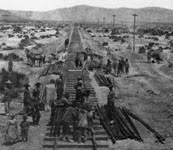
Rail road workers.

Chinese peasants began arriving on the American shores in 1850, they came over because of poverty and the overpopulation of their hometown. These Chinese immigrants faced growing prejudice and increasingly restricted laws. In early 1865 the Central Pacific had work for over 4,000 men but the contractor Charles Crocker couldn't even hold onto 800. working the railroad was a hard job, and not too many people signed up. The workers were mainly Irish immigrants, the Irish were known for spending their paychecks on liquor and the Chinese had no better reputation. But due to the shortages Central Pacific agreed to start hiring the Chinese.

The Chinese workers were organized into groups of 20. Each group had 1 white foreman. The pay for the Chinese workers were about $25-30 a month. The workers lived in canvas camps along the grade. Toward the end of the line, Crocker was convinced of the skills of his Irish and Chinese workers that he decided to try for a record of laying 10 miles of track in one day. The Chinese and Irish workers were working like an organized army laying tracks, making Crocker very proud.